Idea
Applying product prioritisation in our daily decision-making
Product management (PM) isn't rocket science.
Note: But it is abstract. PM can apply to a physical, digital product.
It's essentially being the adult in the room and reminding everyone what is important.
Everyone often has an idea of what's important but you'd be surprised how often people forget.
Businesses need to survive so really workers are running around crazy trying (and often failing) to balance speed of output with quality.
Multiply this by a factor of the size of the business you're in and you have your self an old fashioned mexican stand off when it comes to priorities.
So how does a PM make a priority call?
They consider two things:
-
Value - How important is this. Very subjective. It's essentially the likehood this action will produce the end-goal you want. e.g. By doing [x] it will double my customer base.
-
Effort - How difficult is this to do. Less subjective, more evidential. You know how long it's going to take, "give it a week" or "it's a day task".
We can get really fancy and look at more 'advanced' techniques such as RICE and WSJF. But don't be fooled these are all facades PMs can play to make it look like a well-thought out decision.
In reality, if you know what you want to do, and you have reliable input of Value and Effort, that is more than enough for a quick and effective priority call.
You can present this on an X vs Y axis or a table. Personally, I often go for the axis as it helps with comparison.
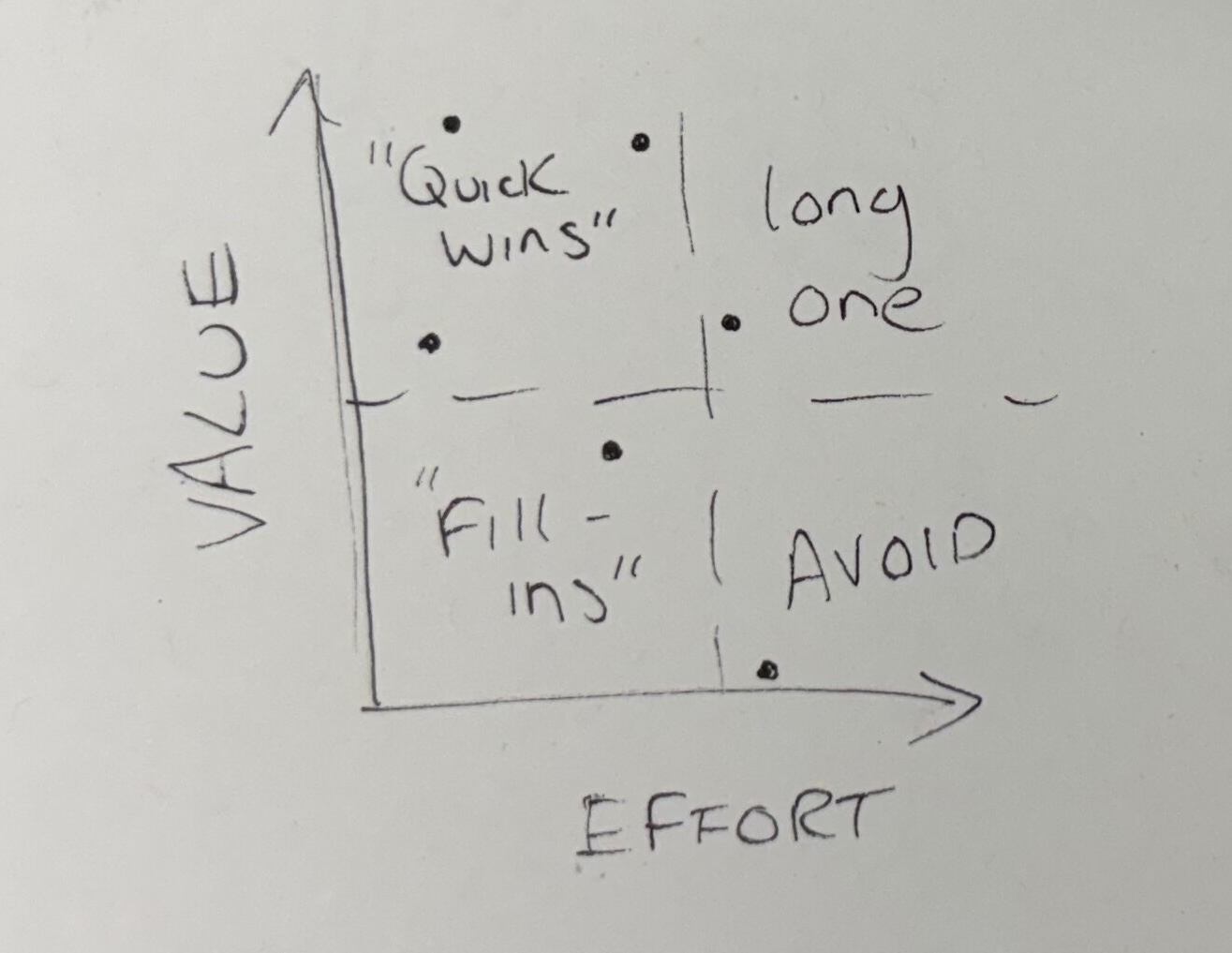
The different combinations tell you the priority to take.
- H (Value) vs L (Effort) - "Quick wins"
- H (Value) vs H (Effort) - long, meaty task
- L (Value) vs L (Effort) - "Fill-ins"
- L (Value) vs H (Effort) - Avoid these!
The cream de la crem is the first type. The easier, higher value items, allow you to taste success early. It builds confidence and trust early which you need to go after the more complex opportunities.
Now let's take this thinking to our personal lives.
We make decisions, constantly.
We buy three or four fancy planners because the other's didn't work.
We try To-do lists.
I'm not against To-do lists. Their simplicity actually works. There's something effective around the analogus approach.
It's just when you decide to tackle the list what order do you take?
Next time, add two more columns to your TO-DO list.
That's right! One for 'Value' the other for 'Effort'.
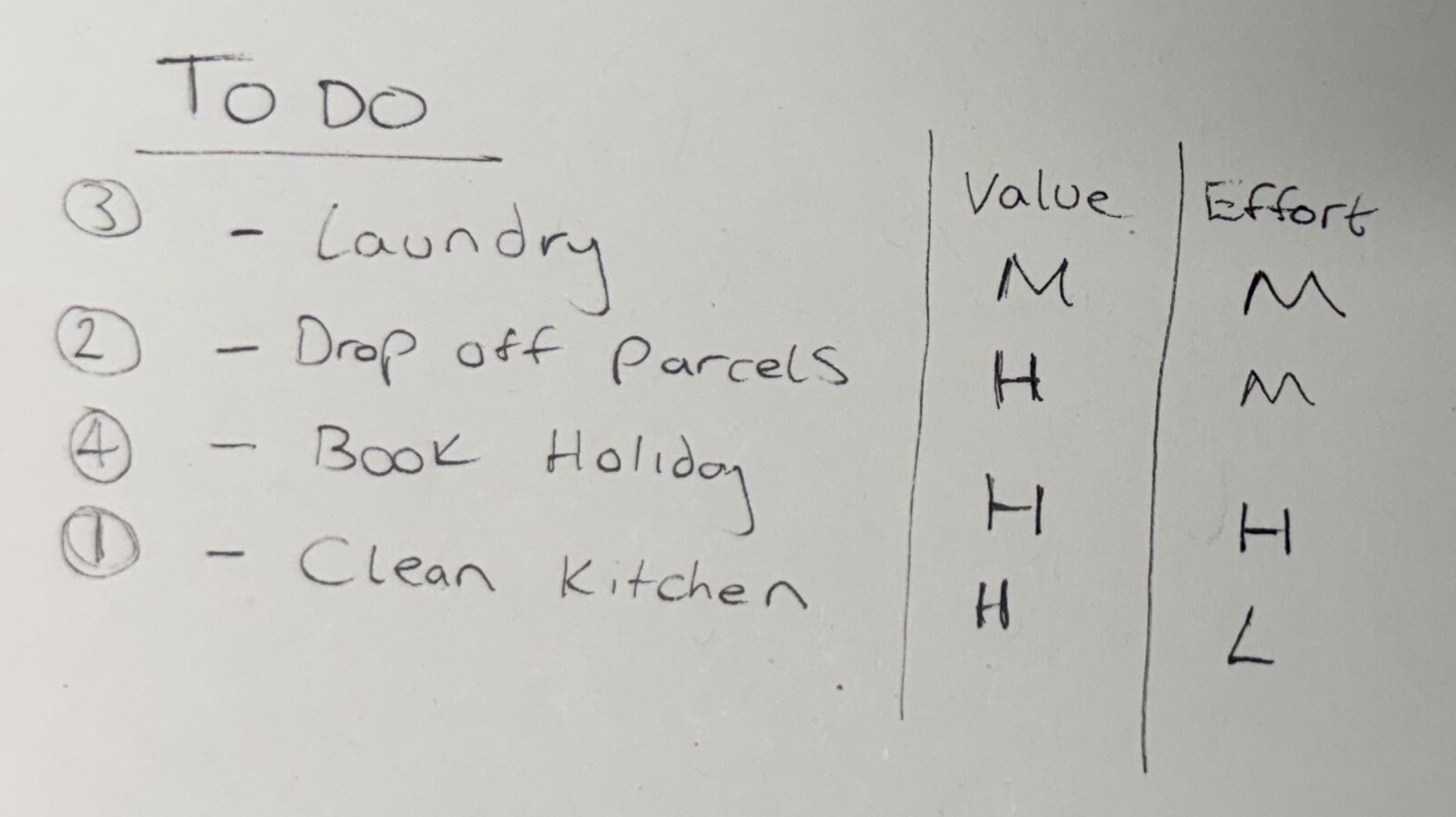
Notice the combination and let that guide your decision.
The advice stops there, no more instructions, no more overcomplication. Something wrong with most advice on the web nowadays.
At the end, keeping it simple consumes less energy so that you can consistently do it.
Good luck :)